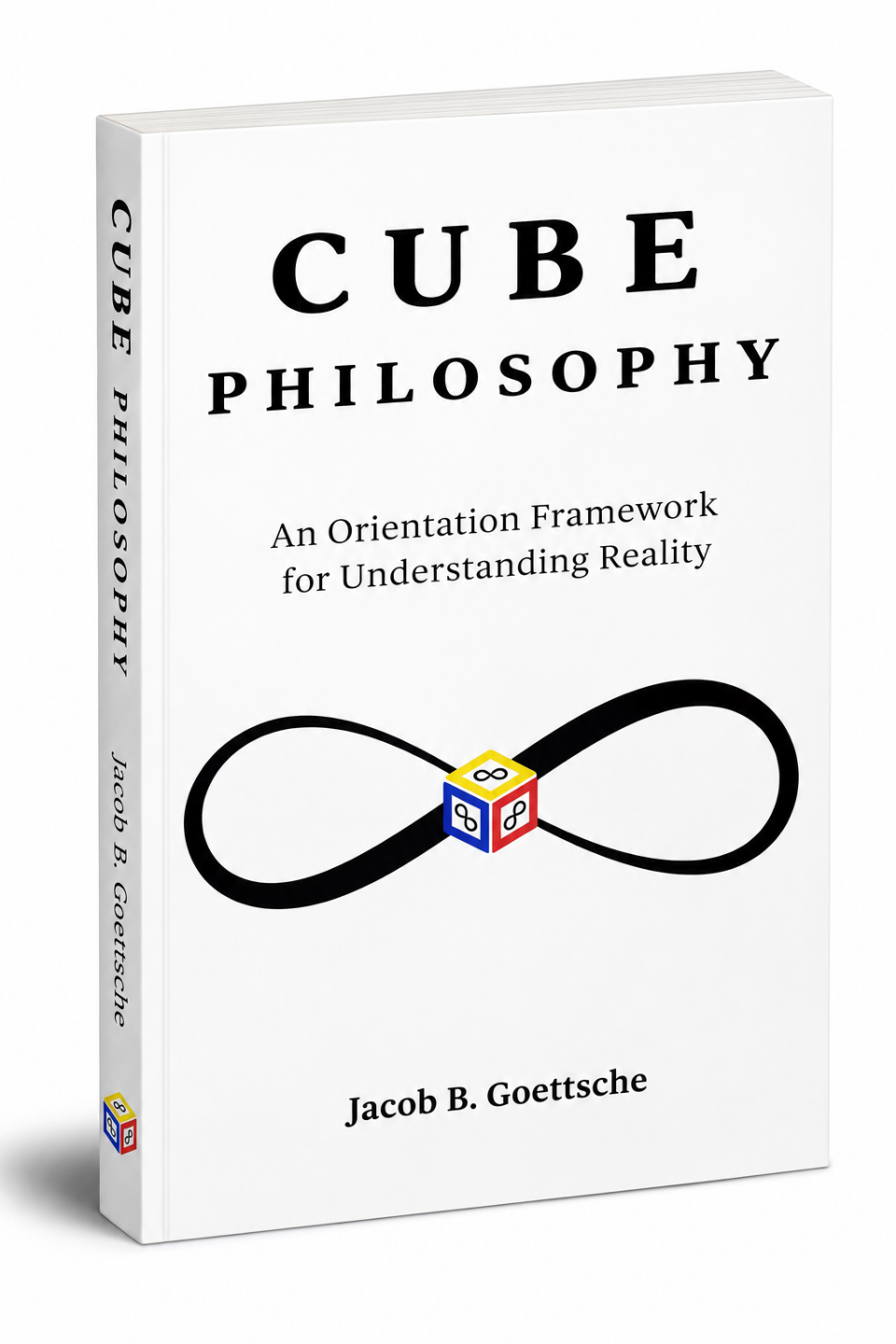
Cube Philosophy
An Orientation Framework for Understanding Reality
What happens when the things you once relied on to make sense of life — certainty, belief, intelligence, experience, even your own perception — are no longer enough?
Cube Philosophy begins with a deceptively simple problem: two sincere people can look at the same reality and come away with completely different understandings of what is true.
Rather than offering another belief system or telling you what conclusions to reach, Jacob B. Goettsche introduces a structural framework for something more fundamental: learning how to orient yourself within reality.
The Cube separates six dimensions of human experience — My Reality, Another Reality, Knowledge, Influence, Positive, and Negative — so they can be examined without collapsing into one another. It then explores the stabilizing role of Ground and five distinct modes through which human beings perceive and interpret what is happening around them.
The goal is not certainty.
It is the ability to remain clear when certainty disappears.
Through the framework, readers are invited to examine the difference between perception and reality, intelligence and orientation, insight and responsibility, meaning and truth — and to recognize what happens when one part of human experience begins operating as though it were the whole.
Cube Philosophy does not ask you to adopt the author's worldview. In fact, it is deliberately designed not to tell you what to believe. Instead, it offers a structure for testing beliefs, insights, decisions, and actions against reality, consequence, responsibility, and time.
For readers who have ever found themselves asking What is actually true? How do I know? What belongs to me? What belongs to someone else? And how do I remain grounded when the answers aren't simple? — Cube Philosophy offers a place to stand.
Because sometimes the answer isn't another conclusion.
Sometimes you need a better way to orient